
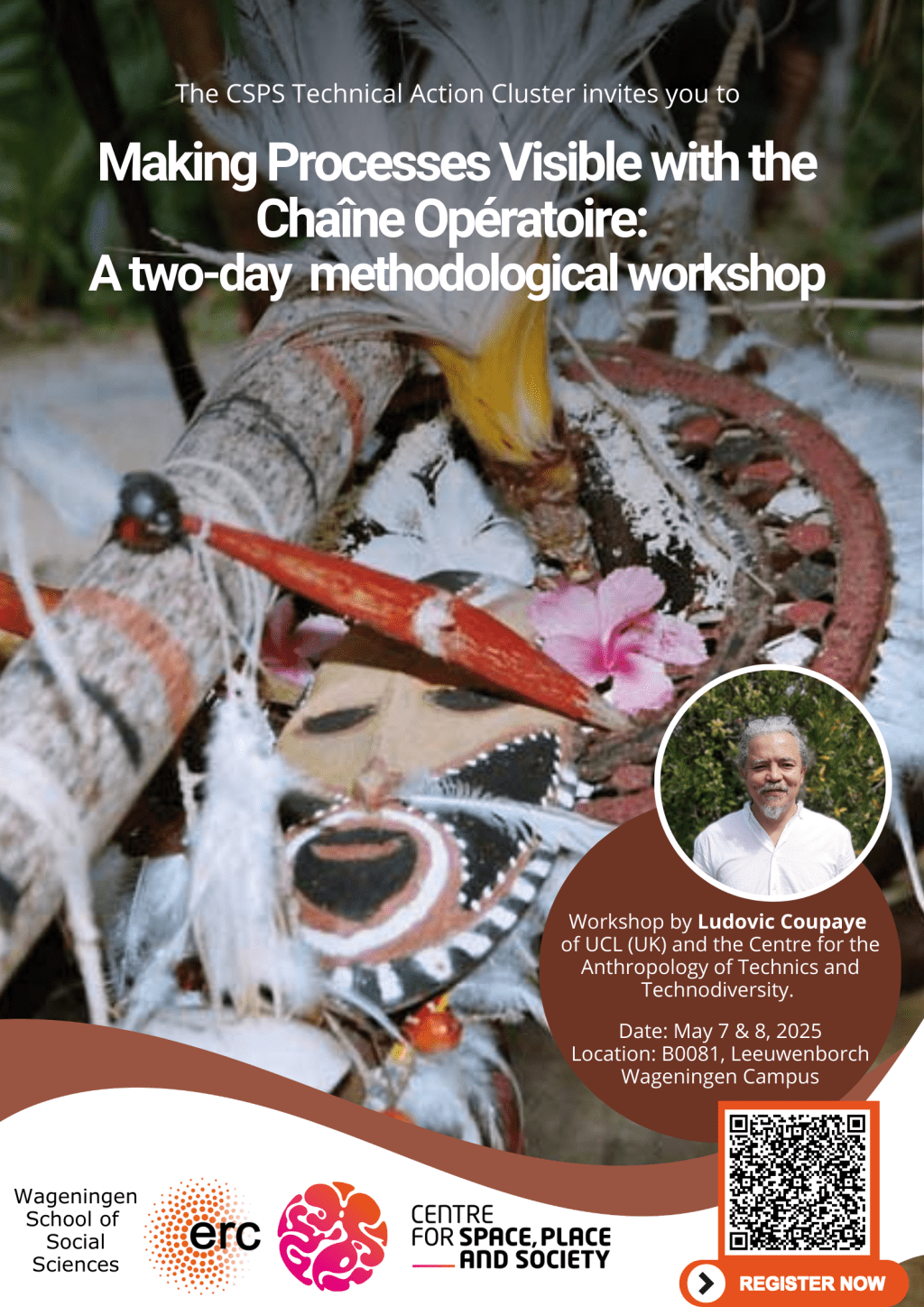
Making Processes Visible with the Chaîne Opératoire: A 2-Day Methodological Workshop
Dates:
> May 7: 10:00 – 16:00
> May 8: 10:00 – 17:00
Location:
B0081, Leeuwenborch, Wageningen University & Research
Costs:
Free of charge. Coffee provided by WASS.
ECTS Credit:
Possibility to earn 1 ECTS credit from WASS.
Workshop Overview:
Join us for a two-day workshop on the Chaîne Opératoire, an anthropological method for documenting and analyzing technical activities. This workshop, led by Ludovic Coupaye, Associate Professor in Anthropology at UCL (UK) and Director of the Centre for the Anthropology of Technics and Technodiversity, is hosted by the Knowledge, Technology and Innovation Group of Wageningen University and Research and the Technical Action Cluster of the Centre for Space, Place and Society.
Day 1
Morning (10:00 – 12:00): Introductory Lecture on the Chaîne Opératoire and the Anthropology of Technics
The session will introduce the concept of Chaîne Opératoire, beginning with a review of the historical development of documenting technical activities in anthropology. We will explore its origins in the work of Marcel Mauss, its evolution in archaeology and anthropology, and its key components.
Afternoon (13:30 – 15:30): Prepping Workshop on the Chaîne Opératoire
This interactive session will prepare participants to document technical activities. We will discuss the key concepts from the morning lecture, examine examples of Chaîne Opératoire drawn by students and researchers, and address questions from the participants.
Evening (16:00+): Documentation of a Technical Activity
After the workshop, participants will document a short technical activity of their choice (no more than 5 minutes). This can be done at home or at another safe, convenient location. The documentation will serve as the foundation for the next day’s activities.
Day 2
Morning (10:00 – 12:00): Graphic Construction of Chaînes Opératoires
Using their notes from the previous day, participants will create graphic representations of the technical activity they documented. These will be uploaded to a shared Padlet platform for further analysis and discussion during the afternoon session.
Afternoon (13:30 – 17:00): Presentation and Methodological Discussion
The afternoon will focus on the analysis and discussion of the Chaînes Opératoires uploaded to Padlet. We will identify key anthropological themes that emerge from the documented activities and explore how this method can provide insights into these themes. We will also reflect on the strengths and limitations of the Chaîne Opératoire approach.
Registration
Spaces are limited. For questions, please reach out to Stephanie Hobbis (stephanie.hobbis@wur.nl). We look forward to welcoming you to this exciting and informative workshop!
Bibliography
Bray, Francesca. 2020. Thinking with Diagrams: The Chaîne Opératoire and the Transmission of Technical Knowledge in Chinese Agricultural Texts. East Asian Science, Technology and Society: An International Journal, 14(2): 199-223.
Coupaye, Ludovic. 2009b. “Ways of Enchanting: Chaînes Opératoires and Yam Cultivation in Nyamikum Village, Maprik, Papua New Guinea”. Journal of Material Culture, 14(4): 433–458.
Coupaye, Ludovic. 2022c. “Making ‘Technology’ Visible: Technical Activities and the Chaîne Opératoire”, in The Anthropology of Technology: A Handbook, edited byMaja Hojer Bruun & Ayo Wahlberg. New York: Palgrave Handbooks.
Dobrès, Marcia-Anne. 1999. “Technology’s Links and Chaînes: The Processual Unfolding of Techniques and Technician”. In The Social Dynamics of Technology, edited by Marcia-Anne Dobrès & Christopher R. Hoffman. Washington & London, Smithsonian Institution Press: 124-146.
Knappett, Carl. 2012. “Network of Objects, Meshworks of Things. In Redrawing Anthropology: Materials, Movements, Lines, edited by Tim Ingold. London: Ashgate Publishing: 45-64.
Lemonnier, Pierre, 1992. “From field to files: description and analysis of technical phenomena”, in Elements for an anthropology of technology, Pierre Lemonnier. Ann Arbor, Mich: Museum of Anthropology, University of Michigan: 25-50.
Lemonnier, Pierre. 1986. “The study of material culture today: toward an anthropology of technical systems”. Journal of Anthropological Archaeology 5(2): 147–86.
Leroi-Gourhan, André. 1971[1943]. Evolution et Techniques I: L’Homme et la Matière. Paris: Albin Michel.
Leroi-Gourhan, André. 1973[1945]. Evolution et Techniques II: Milieu et techniques. Paris: Albin Michel.
Leroi-Gourhan, André. 1993[1964]. Gesture and Speech. Cambridge (Mass.): M.I.T. Press.
Lewis, Michael & Monique Arntz. 2020. The Chaîne Opératoire: Past, Present and Future. Archaeological Review from Cambridge, 35(1): 6-16.
Martinón-Torres, Marcos. 2002. “Chaîne opératoire: the concept and its applications within the study of technology”. Gallaecia, 21 29 – 43.
Porqueddu, Marie-Elise, Claudia Sciuto & Anaïs Lamesa. 2022. Reconsidering the Chaîne Opératoire: At the Crossroad Between People and Materials. Open Archaeology, 9(1): 1-10.
pour quoi faire? Paris: Editions du CNRS.Berman, Marshall.
Schlanger, Nathan. 2005. “The chaîne opératoire”. In Archaeology: the Key concepts, edited by Colin Renfrew & Paul Bahn. London: Routledge: 25-31. A general presentation of the “ChOp”. Good for starter. More archaeologically oriented.
Walls, Matthew. 2015. “Making as a didactic process: Situated cognition and the chaîne opératoire”. Quaternary International, 405: 21-30.
 Centre for Space, Place and Society