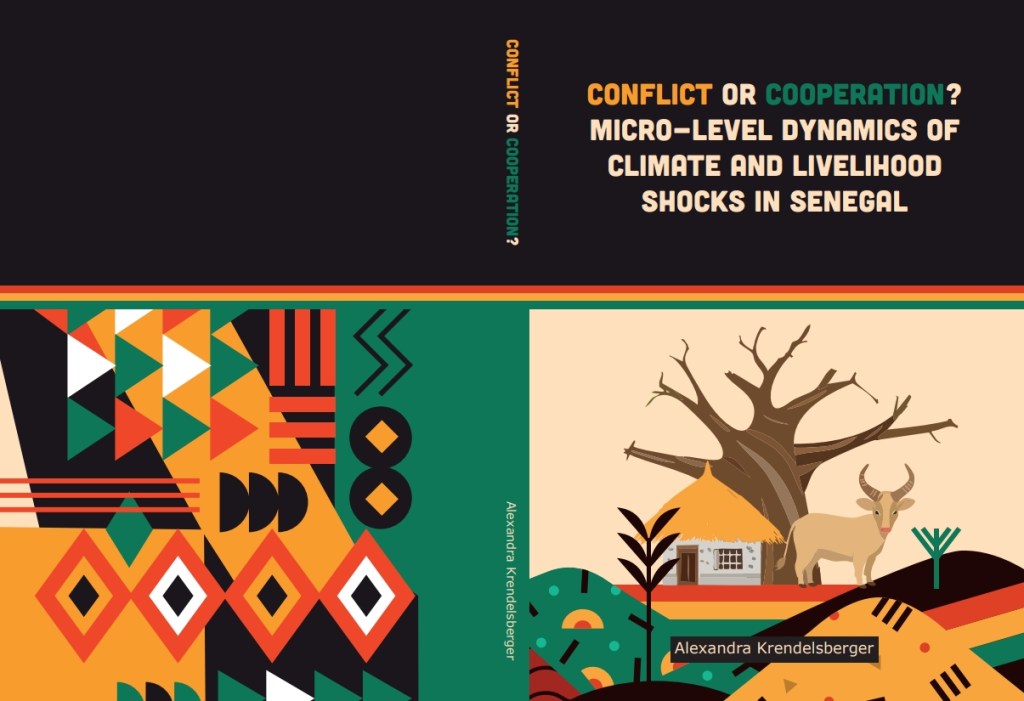
We are proud to share that Alexandra Krendelsberger of the Sociology of Development and Change Group will be defending her PhD thesis titled “Conflict or cooperation? Micro-level dynamics of climate and livelihood shocks in Senegal.”.
When: October 9, at 15:30 PM
Where: Omnia, Wageningen University
Abstract
Climate change and conflict are often portrayed as linked, yet the mechanisms connecting climate variability, livelihood shocks, and intergroup relations remain unclear. This thesis contributes to this debate by developing a new conceptual framework and testing it through four empirical studies primarily focusing on farmer-herder interactions in Senegal using a mixed-methods designs.
The first study examines how climate influences farmer-herder relations through conducting interviews, surveys, and focus groups. Results show that seasonal patterns, governance, and natural resource management play a greater role than climate change. The latter certainly affects farming and pastoral livelihoods but no direct causal link to conflicts could be identified. The second empirical study uses public goods experiments with 424 participants to compare the effects of individual and collective shocks on intra-group cooperation in farming and pastoral zones in Senegal. It finds that collective shocks reduce cooperation, while individual shocks increase it, with pastoralists displaying higher overall cooperation than farmers. These results suggest that extreme climate events, acting as collective shocks, can undermine intra-community cooperation.
The third empirical study explores inter-group dynamics, showing that collective risks intensify in-group favouritism and out-group hostility, particularly against transhumant herders, who are stigmatized as outsiders and troublemakers. Interestingly, ethnic rivalry between Wolof farmers and Fulani herders does not seem to drive the effects, but rather stereotypes and prejudice against the transhumant lifestyle. The last empirical study analyses panel data (2002–2017) on climate, agriculture, conflict, and cooperation. It finds that both conflict and cooperation rise in wetter or hotter-than-usual years, indicating that conflict and cooperation frequently co-occur in response to climate variability.
The thesis concludes that the effects of shocks depend on livelihood resilience, social and geographic context, stereotypes, governance, and alternative livelihood opportunities. It proposes indicators for monitoring farmer-herder relations and calls for a shift in focus from climate-conflict to climate-cooperation dynamics, emphasizing the need for micro-level analysis of how climate shapes both conflict and cooperation.