
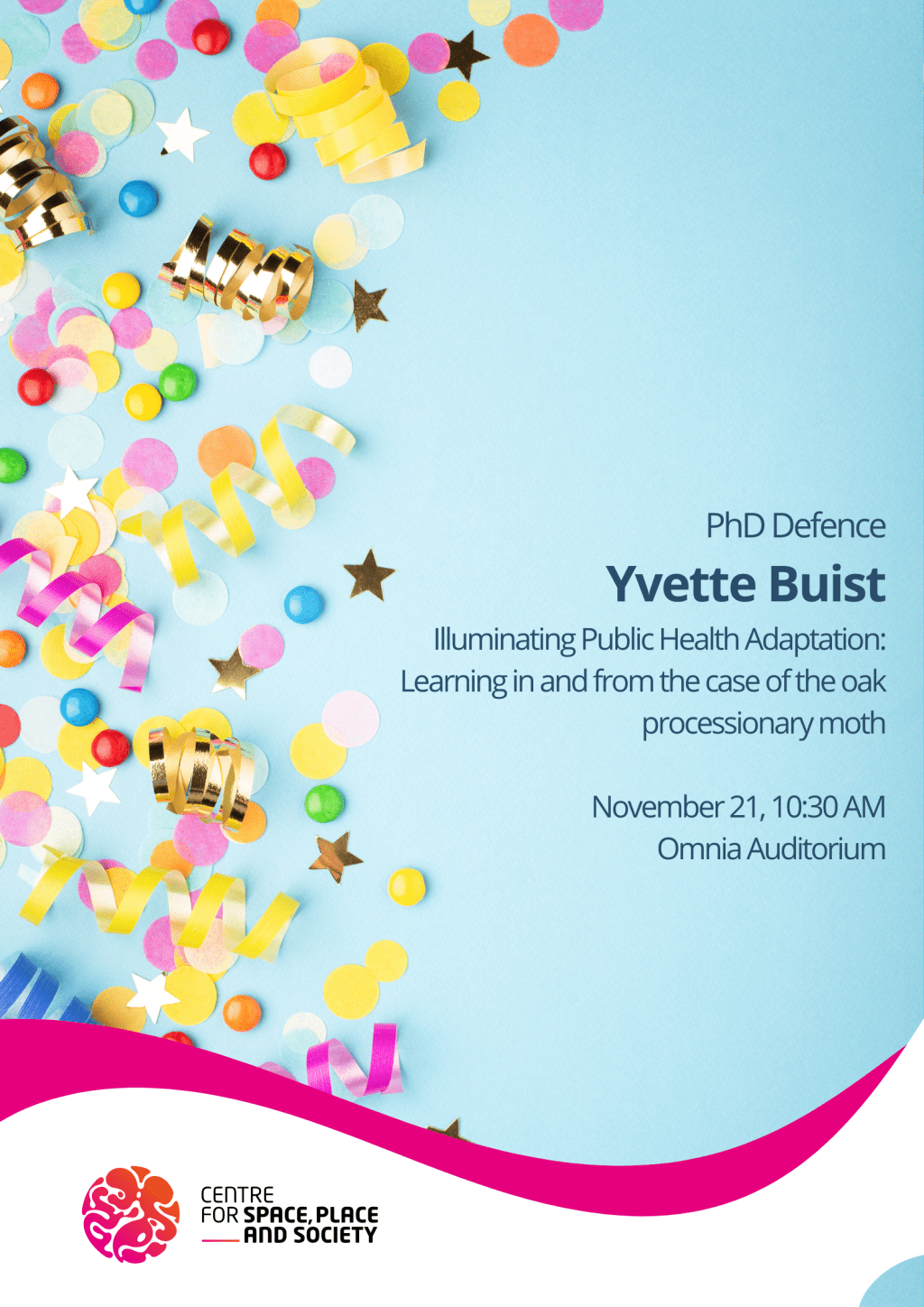
We are proud to share that Yvette Buist of the Health and Society Group will be defending her PhD thesis titled “Illuminating Public Health Adaptation: Learning in and from the case of the oak processionary moth”.
When: November 21, at 10:30 AM
Where: Omnia, Wageningen University

Abstract
This thesis explores how public health adaptation (PHA) develops in the context of climate change, using the oak processionary moth (OPM) as a case study. The OPM is a climate-sensitive species whose hairs pose health risks such as skin irritation, respiratory issues, and allergic reactions. The central research question examines how PHA strategies in Western European countries have evolved in response to the OPM, given the growing complexity of climate-related health challenges.
An exploratory study of OPM adaptation in the Netherlands shows that the organisation of PHA is hindered by three types of challenges. Technical challenges arise from knowledge gaps regarding OPM behaviour, health impacts, and control methods. Organisational challenges relate to unclear responsibilities, insufficient funding, and limited preparedness, resulting in ad hoc responses. Normative challenges reflect conflicting values between rapid health interventions and ecological sustainability. A lack of shared understanding and coordination across governance levels further restricts effective adaptation.
Analysis of the Dutch Processionary Moth Knowledge Platform demonstrates that social learning played a crucial role in developing adaptation strategies. Through collaboration among, e.g. authorities, scientists, and practitioners, new fact sheets, health guidelines, and communication tools were co-created. Social learning refined OPM adaptation through an iterative process of relationship building and idea generation, even amidst contextual challenges such as national elections, the COVID-19 pandemic, and declining OPM numbers and health impacts.
A comparative study of Flanders, the Netherlands, and Great Britain revealed that adaptation processes became increasingly inclusive and multi-dimensional. Initially focused on human health, strategies gradually expanded to incorporate biodiversity and ecological values. Social learning within networks and international collaborations emerged as key drivers of this evolution, helping actors move from reactive responses to more adaptive, context-sensitive approaches.
The thesis concludes that PHA is a complex, cross-sectoral process shaped by uncertainty, evolving knowledge, and diverse stakeholder interests. It recommends reframing PHA as One Health adaptation, recognising the interdependence of human, animal, and ecosystem health. This perspective calls for dynamic, multidisciplinary collaboration to address health challenges that cut across domains. As health risks increasingly stem not only from climate change but also from biodiversity loss, pollution and land-use change adaptive strategies must be inclusive, integrated, and responsive to multiple knowledge systems and societal values.
 Centre for Space, Place and Society