
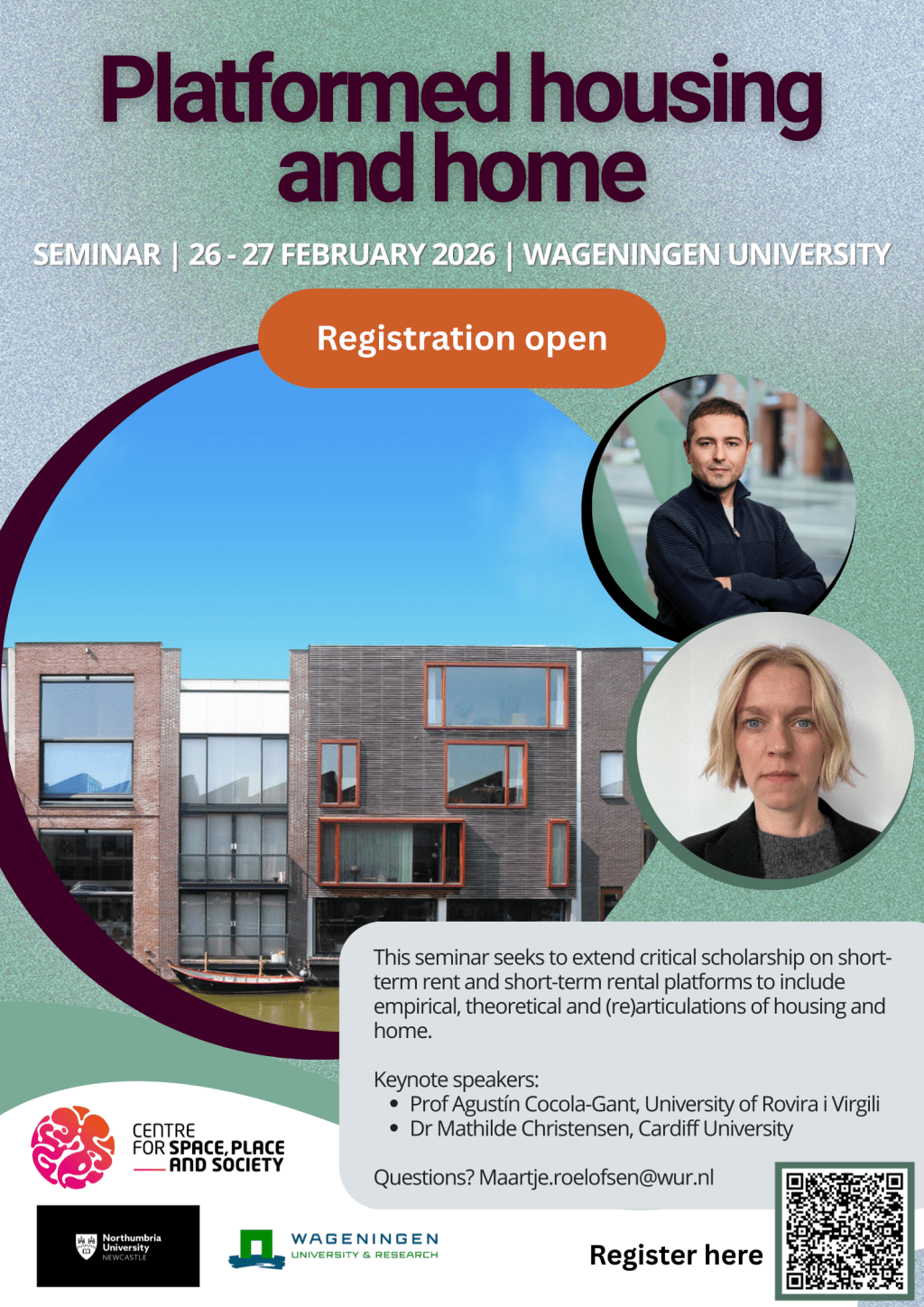
The seminar Platformed Housing and Home brings together international scholars to explore how digital platforms are reshaping housing, labour, domestic life, and power relations. Over two days, the event examines the social, political, and economic consequences of platformisation across different urban and cultural contexts. Below you will find the full programme, including session details, keynote presentations, and practical information about the venue and travel.
Programme and Information
Thursday 26 February 2026
| Time | Description | Location |
| 9:00 | Registration and morning refreshments | Impulse Reception Area |
| 10:00 – 11:00 | Welcome Keynote Agustín Cocola-Gant | Impulse Speakers Corner |
| 11:00 – 12:30 | Session 1: Housing, Tech and Finance | Impulse Ncounter Room |
| 12:30 – 14:00 | Lunch break | Impulse Cafetaria |
| 14:00 – 15:30 | Session 2: Labour and Home part I | Impulse Ncounter Room |
| 15:30 – 16:30 | Session 3: Labour and Home part II | Impulse Ncounter Room |
Friday 27 February 2026
| Time | Description | Location |
| 9:30 – 10:30 | Keynote Mathilde Christensen | Impulse Speakers Corner |
| 10:30 – 12:00 | Session 4: Power and Domesticity | Impulse Ncounter Room |
| 11:00 – 12:30 | Closing remarks | Impulse Speakers Corner |
Location and registration
The two-day seminar and lunches will take place in the Impulse building on Wageningen University Campus. The Impulse building is marked with the number 115 on the following map.
Getting there and around
Please scroll down to the bottom of this document to find some tips regarding travel from/to Amsterdam Airport, Wageningen University and around Wageningen.
Keynotes and Sessions
Keynote 26 February 10:00 – 11:00
PropTech in the short-term rental industry. The digital infrastructure behind Airbnb
Agustín Cocola-Gant
Rovira i Virgili University, Spain
Over the past decade, short-term rentals (STRs) have become a central focus in housing and urban studies, most often through platform-centric analyses that position Airbnb as the primary driver of technological disruption and market transformation. In this presentation I will challenge that narrative by offering a historical re-reading of STR digitalisation that situates Airbnb within a much longer trajectory of technological development rooted in the hospitality industry. Drawing on participant observation at three industry events and 18 semi-structured interviews with market actors, I will trace the historical evolution of STR digitalisation from early online distribution systems to today’s integrated software ecosystems. Adopting an infrastructural perspective, the analysis conceptualises STR markets as organised through an interconnected assemblage of platforms, property management systems, channel managers, pricing algorithms, and analytics tools linked via APIs. I will show how this PropTech infrastructure operates as an obligatory passage point for professional market actors, conditioning access to demand, enabling multi-channel distribution, and producing continuous streams of operational data. By doing so, the intention is to advance platform and housing studies by reframing platform power as infrastructural embeddedness and positioning STR PropTech as a key mechanism through which housing is rendered calculable, mobile, and financialised.
Session 1 Housing, tech and finance 11:00-12:30
Disruption or Dispossession? Venture Capital, Real Estate-start-ups and the Perilous Pursuit of Hypergrowth in Urban Housing Markets
Tim White
London School of Economics and Political Science, United Kingdom
What happens when venture capitalists try to reinvent housing in their own image? Synonymous with the rise of Big Tech, venture capitalists (VCs) are asset managers that invest in early-stage companies, pursuing aggressive growth and market domination. Since the 2008 financial crisis, VCs have poured vast sums into real estate start-ups targeting short-term rentals. Yet these actors are largely overlooked in the platform real estate literature. Attending to this gap, this paper traces VC-driven attempts to build a globally scaled residential operator and examines the resulting social harms. It closely follows investment, acquisition and consolidation activity in the ‘co-living’ sector over the past decade, and the everyday impacts of this activity upon tenants via interviews and auto-ethnography in co-living spaces. I show how venture capitalists have pushed these start-ups to pursue unprofitable and unsustainable growth, rapidly increasing the number of beds under operation and cities covered. But faced with the complex, costly and variegated reality of housing systems, they invariably incur spiralling losses. It is the tenants who pay the price – enduring negligence, under-maintenance, new forms of financial extraction, and dispossession. I examine how residents bear the brunt of this on a gendered, interpersonal and emotional level. In so doing, the paper interrogates a vital set of actors underlying the housing-tech-finance nexus, and the consequences of their experimentation for households and cities.
Perception, Positionality and the Politics of STR Regulation
Christian Smigiel
University of Salzburg, Austria
The rise of short-term rentals (STR) has been a highly debated political issue in many European cities in the last years. Misuse of residential space, rising rents and house prices as well as temporary vacancies are just three problematic aspects associated with short-term rentals via online platforms (Bei & Celata 2023). In Salzburg (Austria), a touristified city that has the highest percentage of STR per capita among Austria’s bigger cities, it even led to an unusual success of the Communist party (KPÖ plus) in the last local election which gained almost 25% of the votes. But even before the 2024 election the public debate about Airbnb, Booking, Vrbo etc. resulted in a series of regulation measures especially on the local scale. This paper will discuss this regulation scenery briefly at the beginning. Second, I will reflect on how different types of hosts perceive and react to regulation and control. This includes an insight into positionality and social practices of STR hosts on one side as well as a reflection on the meaning of home and property rights on the other side. My analysis is based on a long-term study of STR in Salzburg (2018–2025) in which I have studied different dimensions of housing in times platform capitalism using a mixed methods approach (Smigiel 2024). Therefore, I will conclude with an attempt that brings together socio-material, political and cultural aspects of platformed housing.
Leah Aaron
University College London, United Kingdom
This paper focuses on rental platforms as a medium for accessing the rental sector in Berlin, a city marked by population growth, a shortage of housing stock, assetisation, and an inflexible market characterised by low vacancy rates. Under these conditions, accessing the formal rental sector is challenging and, as Bernt et al. (2021) put it, ‘all but closed’ to migrants, who struggle to position themselves as culturally desirable tenants within an unfamiliar landscape of largely institutional housing provision. Digital platforms, with their intuitive interfaces and translation mechanisms, appear to offer a means of bypassing such barriers to accessing accommodation. Yet these platforms are imperfect technical mediators of a highly distorted housing market. Drawing on digital-ethnographic research with ‘international’ middle-class migrants in Berlin, I argue that reproductive work also occurs beyond the boundaries of the home—specifically through the activity of using digital platforms to gain entry to the rental sector. This labour unfolds in variegated ways but invariably requires significant time, care, and resources. I analyse these efforts through two overlapping forms of digital-reproductive work: ‘technical’ and ‘social.’ Whilst ‘technical’ work focuses on engineering and optimising the affordances of commercial rental platforms to the accommodation-seeker’s advantage, ‘social’ work involves digital activities that position the self as a potentially desirable tenant. This often takes place via consumer-to-consumer (C2C) platforms with lower levels of technical affordance and embeddedness with financial and credit-referencing databases. As I make clear, whilst both practices operate with distinct rhythms and temporalities, each significantly shapes participants’ life-worlds, imaginaries of home, and everyday experiences of belonging.
Session 2 Labour and home: part I 14:00–15:30
Spaces of refuge and contradiction: Cleaning workers, housing resources and short-term rental platforms
Kiley Goyette
University of Toronto, Canada
Short-term rental (STR) platforms like Airbnb depend on on cleaning labour to operate. These cleaning workers are often socially and/or economically marginalized, and are themselves dependent on affordable housing stock in their communities. While workers recognize certain advantages to cleaning STR properties, particularly those who face discrimination in other employment fields, they are also cognizant that their labour is being used to erode access to affordable housing, contributing to the conditions of precarity that they and their communities face. Cleaners navigate these contradictions by engaging diverse strategies to balance their own economic needs with the harms to which their work risks contributing. Based on interviews with differently situated workers hired to clean STR properties in Montreal and Toronto (Canada), my research explores the experiences of cleaners as workers, their intersectionality, and their social reproduction strategies through a platform urbanism approach.
The invisible labour behind Short-term rentals: Gender and commodification of social reproductive labour
Mar Alsina-Folch and Maartje Roelofsen
Open University of Catalonia, Spain
This paper presentation examines the labour that sustains short-term rental (STR) housing in Amsterdam (the Netherlands) and Barcelona (Spain). Based on semi-structured interviews with Airbnb hosts, we outline how different forms of social reproductive labour are commodified, divided and outsourced within STR markets to enable the continuous provision of serviced accommodation and to extract surplus value. Drawing on social reproduction theory and feminist perspectives on service work, we explore the labour relations and workplace hierarchies in urban STR markets, highlighting how the means of production and the social and economic benefits accrued through STRs are unevenly distributed. Our findings reveal that, while STRs can be both the site of commodity production and of social reproduction, the labour that is needed for the extraction of value is predominantly performed by women who usually always already carry out related domestic tasks without reward. Moreover, while both men and women perceive STR work as a job, women emphasize the challenges of balancing multiple roles in their lives. They will relinquish or delegate essential social reproductive work to other members of the household to accommodate STR and tend to feel ashamed about this. Emotional labour is generally preferred over manual tasks, which are often outsourced to migrant women when possible. This study contributes to theoretical understandings of social reproductive labour under platformisation, exposing gendered and racialized dynamics in the STR economy.
Host Subjectivities: Airbnb and the Platformization of Home
Jelke Bosma
University of Amsterdam, the Netherlands
Dominant political-economic approaches of short-term rental platforms centralize the role of capital and hosts’ economic behavior. However, in some cases, hosting practices and strategies might appear economically irrational. To understand what brings individual hosts to Airbnb and what keeps them there, we must understand how they see themselves and their role as hosts. In this article, I explore how the short-term rental platform Airbnb produces and depends on host subjectivities: a sense of self as entrepreneurial and caring, which is closely bound to imaginaries of home. Host subjectivities allow hosts to not only rent out a room or their entire home, but also to commodify their care. This comes, however, with inherent tensions: while hosting in itself might be valuable for hosts — meeting new people, taking care of them and showing them their world is joyful and rewarding — it also requires labor — including cleaning and other socially reproductive tasks. Host subjectivities are instrumental for Airbnb as they mute hosting labor and foreground aspects of care and entrepreneurship.
Session 3 Labour and home: part II 15:30 – 16:30
‘Home-like’ Home: Renters’ perceptions and homemaking practices in Airbnb stays.
Anna Pechurina
Karlstad University, Sweden
Providing a feeling of home and an authentic experience are considered important aspects of home-sharing services, which have grown in popularity in recent years. This presentation draws on a qualitative study of Airbnb, exploring how renters experience ‘home’ and ‘feeling at home’ within the context of platform-mediated, short-term accommodation. Contrary to literature that emphasises the importance of familiar settings and an authentic, homely feel, this paper argues that both hosts’ and guests’ homemaking practices may aim to establish a sense of distance. Hosts mark shared areas through instructions, labels and sticky notes, encouraging guests to be independent and self-sufficient. Simultaneously, guests ‘volitionally’ dismiss routines and practices associated with a feeling of home and everyday domesticity. As a result, both hosts’ and guests’ practices contribute to Airbnb’s distinctive ‘home-like’ atmosphere, engaging in a form of emotional labour that combines a feeling of welcome with detachment and estrangement. The paper offers insights into perceptions of home from the perspective of users of sharing platforms – where residents neither intend nor are expected to fully inhabit the environments of domestic life. As such, the more estranged way of homemaking illustrates a way of coping with housing arrangements shaped by their transient and commercialised nature.
Reclaiming ‘home’ and ‘homemaking’ in Uganda through digital platforms.
Christine Ampumuza and Doreen Kirungi
Kabale University, Uganda
Digital platforms such as Airbnb, homestay.com, and booking.com have transformed the global accommodation sector. This paper draws on the first author’s experience initiating a homestay program in Southwestern Uganda and a netnography of the homestay.com website to reflect on the concepts of home and homemaking. The paper is based on five meetings, four home visits, and a narrative analysis of the content posted by the 164 homes registered and listed on the homestay.com website. Insights from this analysis are contrasted with stories about the traditional home and hospitality obtained from 11 elderly persons across the country. The findings indicate that home, in the traditional Ugandan sense, was understood as a social space for hospitality, celebration, economic and cultural exchange, connection, bonding, and, at times, conflict. However, with more working family members, the home also became a place of isolation and loneliness, especially for older retired folks whose aspirations now differ from those of the younger generation. As a result, the opportunity of welcoming guests, whether they are tourists, students, experts, city-break weekenders, or relatives, reclaims the essence of a home. Digital platforms enable this by creating a virtual meeting point between guests seeking reconnection through immersive interactions and homeowners seeking to earn from a part of their home space. In that arrangement, the home becomes a space of complex socio-economic and aesthetic negotiations at the individual guest-host and household levels, which cannot be taken for granted.
Keynote 27 February 9:30 – 10:30
Navigating the Platformed Home: A Performative Framework for Diverse Hosting Practices
Mathilde Dissing Christensen
Cardiff University, United Kingdom
This presentation explores the taken-for-grantedness of platform-facilitated short-term rentals to uncover the diverse forms of hospitality and homemaking produced through platforms like Airbnb. While current scholarship offers rich insights into the rise of professionalization within the sector, this presentation argues that more attention must be paid to the varied modes and compositions of hospitality that exist within short-term rental markets. By centering the role of the host rather than the guest, the presentation utilizes a performative framework to develop five distinct modes of hospitality, each of which produces and is produced through different homemaking practices. Ultimately, the argument moves beyond a prevailing political ecology perspective to better capture the complexities and lived experiences of navigating these digital platforms. I contend that despite the dominance of professionalized models in certain urban locations, platforms inherently allow for a “messiness” and a diversity of hosting styles that reshape understanding of the domestic sphere. By examining these diverse approaches, the presentation provides a unique understanding of how platform hospitality continues to transform the relationship between private homes and public markets.
Session 4 Power and domesticity 10:30 – 12:00
Honour, Domesticity and Gendered Authority in Conflict-Affected Middle Eastern Contexts: A Theoretical Intervention on Temporary Housing
Wisam Abu Ghosh
University of Westminster, United Kingdom
This theoretical paper examines temporary housing markets through Middle Eastern feminist perspectives on domestic space, patriarchal authority and women’s spatial vulnerability, with attention to conflict-affected contexts such as Palestine. Scholarship on short-term rental platforms generally assumes that individuals, especially homeowners, can autonomously monetise domestic space. This assumption does not hold in cultural settings where the home is morally governed, collectively controlled and linked to family honour, nor in areas where political instability heightens the need for privacy and safety. Drawing on feminist geography, postcolonial theory and regional gender studies, the paper argues that women’s participation in temporary accommodation is shaped by the intersection of patriarchal norms, limited property ownership and cultural expectations surrounding modesty, gender segregation and household reputation. In the Middle East, and particularly in occupied or militarised areas, women face intensified forms of vulnerability if strangers enter the home, including moral judgment, reputational harm and heightened security concerns. Women’s restricted authority over property further limits their ability to decide whether the home can be used for shared-economy hosting. Even where economic incentives exist, hosting foreign guests may conflict with deep-rooted cultural and political scripts that frame the home as a protected domestic and symbolic refuge. By foregrounding these cultural, historical and conflict-specific dynamics, the paper offers a theoretical intervention that expands Theme 3. It demonstrates that temporary housing must be understood within gendered, collective and politically charged domestic regimes rather than universalised platform models.
From Fridge Magnets to Folded Towels: The Hotelisation of Home in Short-Term Rental Platforms.
Pau Obrador
Northumbria University, United Kingdom
Short-term rental platforms like Airbnb promise a sense of homeliness but increasingly reproduce the conventional imaginaries of the hospitality industry. Some adopt neutral, IKEA-like interiors, while others enhance them to align with boutique-hotel aesthetics. This paper develops insights into the hotelisation of platformed homes to examine how domestic interiors are reshaped to resemble hospitality spaces. The relationship between homes and hotels has been widely discussed in academic literature, but mainly from the hotel industry’s perspective, with little consideration of its impact on the material fabric of the home. By focusing on home interiors, this paper shifts this perspective, extending existing research on the disciplining power of short-term platforms to include their effects on the material fabric of the home. It presents empirical results from the British Academy small grant project on the mediation of the home through short-term rental platforms. The project proposes a micro-geographical analysis of platforms using a combination of semi-structured interviews and visual analysis of platformed homes, combining face-to-face research with platform-based approaches. This paper addresses an important research gap by rematerialising the study of home, emphasising that the digital is not merely an external layer but a fundamental aspect of it. By doing so, it highlights that the impact of the platform economy is far more significant than we often realise, as we face the commodification of domestic spheres.
Platforming the home through image-based speculations.
Dave Loder
University of Edinburgh, United Kingdom
‘Platforming the Home’ is an ongoing series of image-based speculations on the imaginaries of home and practices of domesticiy emergent from short-term rental platforms. Informed by findings from semi-structured interviews and discourse analysis, the visual speculations have been developed via GenAI techniques that give critical focus to the algorithmic condition of interiors on short-term rental platforms. Leveraging te intersecting patterns of homogeneity and novelty that exemplify image-based GenAI, the speculations prototype new ideals and practices that manifest dis/connections with the algorithmic condition of short-term rental interiors. By focussing on the impacts of platform economies inside the home, the ongoing series of images will contribute to understanding the digital reordering of the domestic sphere.
Getting there and getting around
Trains and train tickets
Most attendants have indicated that they arrive at Amsterdam Schiphol Airport. The airport has its own train station underground. From Schiphol Airport there is a direct train to Ede-Wageningen train station, which departs every 30 minutes between 6:00 and 22:00. Tickets can be booked ahead of time via the Dutch Railways website here: https://www.ns.nl/en
When booking the tickets, keep in mind that the departure station is “Schiphol Airport” and the arrival station is “Ede-Wageningen”. Return tickets are valid on the day itself so make sure to book two one-way tickets instead of a return ticket, unless you are returning on the day itself.
Once you arrive at Ede-Wageningen train station, take the staircase or elevator down from the platform and walk towards the bus platform.
Busses and bus tickets
Bus numbers 103 and 303 run every 10 to 15 minutes between Ede-Wageningen train station and Wageningen University campus and Wageningen Centre. Additionally bus number 86 runs between the train station and Wageningen Centre, but does not stop at campus. All three bus lines will take you to Wageningen City Center (Wageningen Busstation) from which it’s a 5-minute walk to the hotel(s). If you are heading straight towards campus and the Impulse building you can take bus 103 or 303 and get off at the bus stop “Bushalte Campus/Omnia” or “Bushalte Bornsesteeg”. The walking distance from the two bus stops to the Impulse building are about the same.
The bus trip between Ede-Wageningen train station and Wageningen Centre will take approximately 25 minutes. The bus trip between Ede-Wageningen train station and Wageningen University campus will take approximately 15 minutes. The bus trip between Wageningen Centre and Wageningen University campus will take approximately 10 minutes.
To make use of the bus hold your contactless debit card, credit card or mobile phone against the card reader at the entrance of the bus. Remove your card from your wallet to prevent another card from being scanned as well. Importantly, follow the same procedure when you exit the bus so the correct fee is deducted. The bus fare will be debited directly from your bank account.
Which cards can you use to check in and out on buses?
Debit or credit cards from Mastercard, VISA or ICS (including foreign accounts and cards). Not accepted: American Express.
Debit cards from ABN AMRO, ASN Bank, bunq, ING, Knab, Rabobank, RegioBank, SNS, Triodos, Van Lanschot, Revolut, Paysafe and Vivid. Not accepted: Van Lanschot with the Maestro logo.
Debit cards on your mobile phone or smartwatch. Not accepted: Paysafe.
https://www.ovpay.nl/en/paymentcard
If you wish to purchase a public transport ticket in another format, please consult the following website or visit one of the information stands at the airport: https://www.ns.nl/en/door-to-door/bus-tram-metro.html
Questions
If you have any further questions, please contact Maartje Roelofsen at: maartje.roelofsen@wur.nl
 Centre for Space, Place and Society