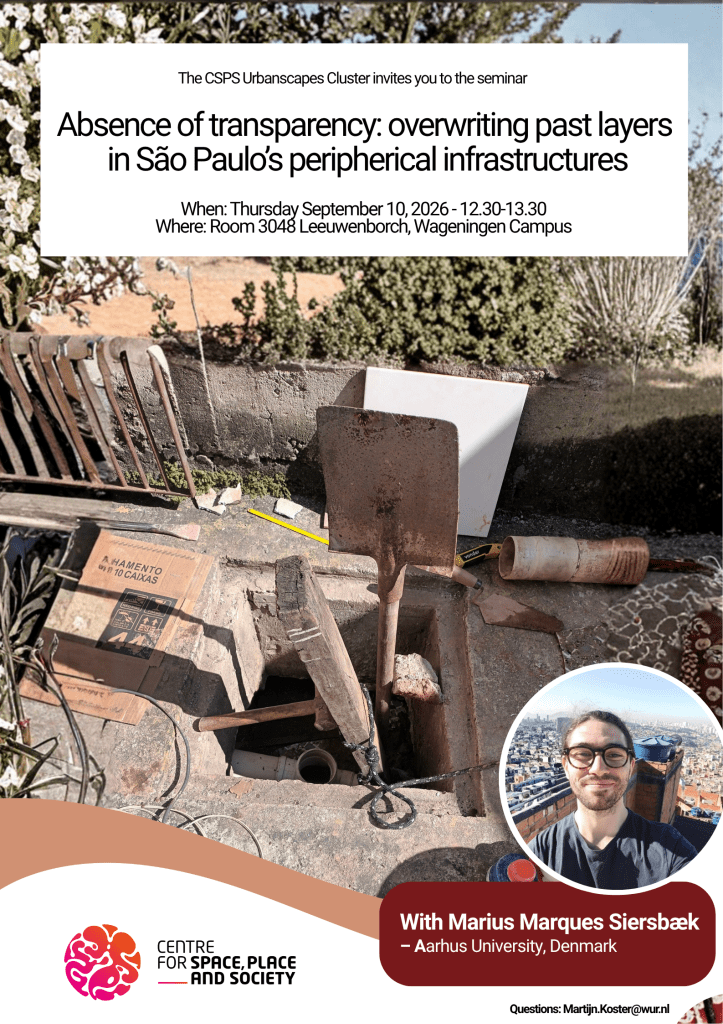
Absence of transparency: overwriting past layers in São Paulo’s peripherical infrastructures
We are pleased to invite you to an upcoming seminar by Marius Marques Siersbæk (Aarhus University), an ethnographer working on infrastructure, migration, and urban peripheries in Brazil.
In this talk, Siersbæk explores infrastructural assemblages in the periphery of São Paulo, arguing that they can be understood as bottom-up structures that are retrospectively legalized by state authorities. Based on ethnographic fieldwork in a favela in São Bernardo do Campo, he shows how the recurring breakdown of infrastructure not only threatens materially grounded relations between residents, but also continuously produces new ones.
A key focus of the presentation is the ambiguous nature of repair. While repair can be transformative—changing the structure it seeks to fix—it can also be restorative, aiming to return something to a prior state. However, in the context of the favela studied, a stable “previous condition” is often not recoverable. Built environments are layered through successive, heterogeneous acts of construction, carried out by different actors with different “styles,” making origins difficult to trace.
As a result, repairing and breaking become closely intertwined processes. Peripheral infrastructures emerge as “black boxes” that residents (moradores) cannot fully disentangle or intervene in without simultaneously overwriting earlier layers of material history.
📅 Date & time: Thursday 10 September 2026, 12:30–13:30
📍 Location: Room 3048, Leeuwenborch Building, Wageningen Campus
💻 Online link
Biography
Marius Marques Siersbæk is a PhD researcher at Aarhus University, Denmark, based in the Department of Anthropology within the School of Culture and Society. Trained as an ethnographer, his research focuses on how Northeast Brazilian migrants in the São Paulo Metropolitan Area navigate conditions of deindustrialization that have rendered conventional pathways of social mobility—such as self-construction (autoconstruction)—increasingly precarious.
His work is based on one year of ethnographic fieldwork conducted since 2023, primarily in a favela in São Bernardo do Campo in the southeastern part of the metropolitan region.